Google forgives your JavaScript. The models don’t.
A colleague sent me this article recently. My oh my how things have changed in just one year.
The article was HubSpot’s guide to JavaScript SEO, last updated in May 2025. It’s a competent piece. Rendering explained. Meta content covered. Expert tips included. If your goal is to be found by Google, it still holds up.
That’s the problem. Being found by Google is no longer the goal. It’s the qualifying round.
The world that article was written for
For twenty years, technical SEO had one reader that mattered: Googlebot. And here’s the thing nobody appreciated at the time. Googlebot is the most forgiving reader on the internet. It queues your page, executes your JavaScript, waits for your React components to hydrate, and eventually indexes whatever appears. Slow? Sometimes. Imperfect? Occasionally. But it happens.
So an entire generation of marketers and developers internalized a comfortable rule: Google can read JavaScript, so we’re covered.
Then the reader population changed.
The new readers can’t read
Buyers don’t start with ten blue links anymore. They ask ChatGPT. They ask Claude. They ask Perplexity. An AI system builds the Silent Shortlist before a human salesperson ever enters the conversation. And the crawlers feeding that shortlist behave nothing like Googlebot.
GPTBot. OAI-SearchBot. ClaudeBot. PerplexityBot. Meta-ExternalAgent. Not one of them executes JavaScript. They fetch your raw HTML, pull the text, and leave. No rendering queue. No second pass. No patience.
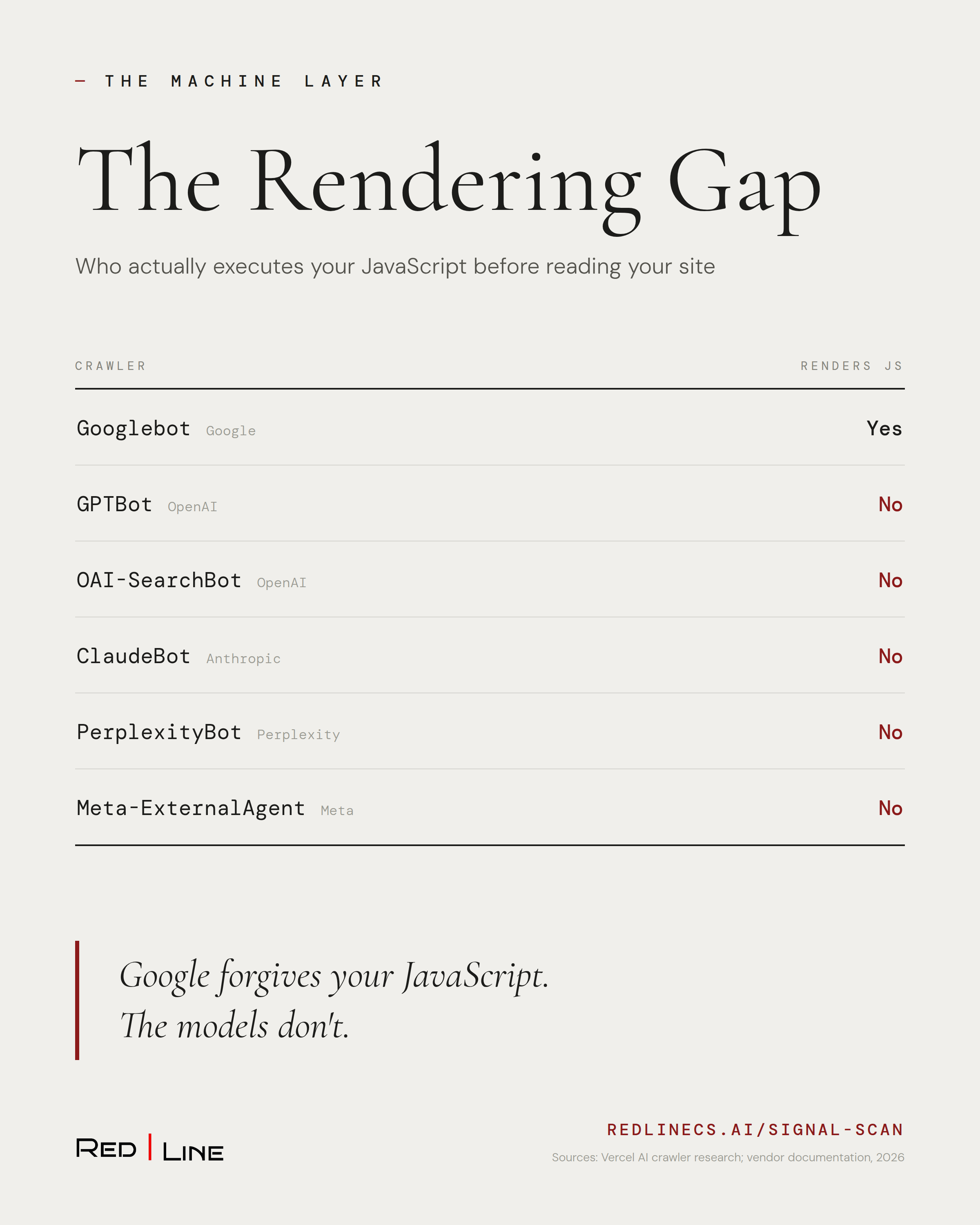
Vercel’s research on AI crawler traffic made it concrete: ClaudeBot downloaded JavaScript files in roughly 24% of its requests and never ran a single one. The crawler picks up your scripts, looks at them, and walks away.
Which means if your site renders client-side, if your headline and your value proposition and your product story only exist after JavaScript executes in a browser, then to the systems building the shortlist, they don’t exist at all.
Not ranked lower. Not summarized badly. Absent.
Naming the problem
There’s now a measurable distance between what Google sees and what the models see. That distance is the Rendering Gap.
On one side: Googlebot, running a full rendering pipeline, reading your site the way a human browser does. On the other: every major AI crawler, reading only the raw HTML your server returns in the first response.
And the two sides are moving in opposite directions. On March 4, 2026, Google removed the “Design for accessibility” section from its JavaScript SEO documentation. The guidance that told developers to test their sites with JavaScript disabled. Gone. Google’s changelog called the information out of date and no longer helpful.
So in the same twelve months that HubSpot article aged, Google told the world to stop worrying about JavaScript while the fastest-growing class of readers on the web became the least capable of reading it. The most important new audience in the history of the web showed up, and the official guidance waved everyone in the other direction.
A true story
We ran a Signal Scan™ for a founder recently. Sharp positioning. Clean copy. Respectable score. Then we ran one more test: right-click, View Page Source, search for the headline.
Not there.
The site was built on a popular no-code platform that renders everything client-side. In a browser, gorgeous. In the raw HTML, an empty shell and a script tag. Every AI crawler that visited left with nothing. The founder had crafted a message the machines were never going to hear.
The fix wasn’t a rewrite. It was server-side rendering, available as a platform upgrade. And the acceptance test takes ten seconds on your own site, right now: View Page Source. Is your headline in it? If yes, the models can read you. If no, you’re invisible to the shortlist.
One caution: not the DevTools inspector. That shows the rendered page, the flattering mirror. View Page Source shows what the crawler actually receives.
What survives from the old playbook
Here’s the twist. The single best line in that HubSpot article has aged up, not down. Technical SEO expert Kristina Azarenko’s advice: make sure all important content is available in the source code, before JavaScript executes.
In 2025 that was a best practice. In 2026 it’s a survival requirement.
Because everything else in classical SEO still matters, just for a new reason. Title tags, h1 elements, meta descriptions, schema markup: these are no longer decoration for a ranking algorithm. They’re how a model with one fetch and zero patience decides which claim on your page is THE claim. In our work we split machine-layer failures into two types: readability failure, where the model can’t parse your content, and salience failure, where it can read everything but can’t tell what’s primary. The Rendering Gap is readability failure at industrial scale. Fix it and you’ve earned the right to fail the second test.
Three things to take back to your team
-
SEO didn’t become wrong. It became insufficient. The old playbook still gets you into Google. It no longer gets you into the answer.
-
You now build for the least capable reader in the room. And the least capable reader builds the shortlist.
-
The test costs nothing. View Page Source. Search for your headline. Ten seconds decides whether the machines can hear you at all.
If you want the machine’s actual verdict on your messaging, run a free Signal Scan at redlinecs.ai/signal-scan. It scores what the models can see. Which, as we’ve established, may be less than you think.
The Rendering Gap is closing for the companies that know it exists. Everyone else is writing beautiful copy for readers who never arrive.
Defy the algorithm.
Sources: HubSpot, “How Your JavaScript Can Benefit Your SEO” (updated May 2025); Vercel, “The Rise of the AI Crawler”; Google Search Central documentation changelog, March 4, 2026.